

Lot n° 52
Estimation :
9500 - 15000
EUR
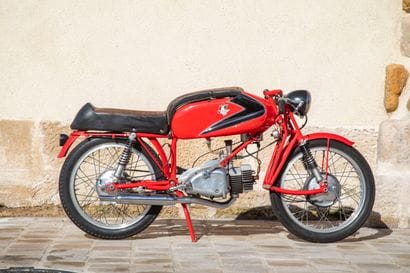
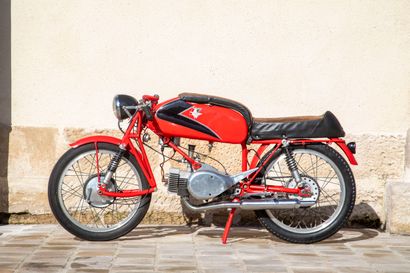
1952 RUMI JUNIOR - Lot 52
1952 RUMI JUNIOR
N° 155SS173
Collection car registration
Frame no. 155SS120
Engine no. 2XX12290
Approx. 300 products
9 500 / 15 000 €
Rumi was founded in Bergamo, Italy, in the early 20th century.
The company originally supplied components to the textile industry. During the Second World War, it produced miniature submarines and torpedoes.
Headed by Donnino Rumi, the company turned to motorcycle manufacturing at the end of the war, introducing its first Turismo model in 1950.
This little gem was powered by what was to become Rumi's trademark engine, a 125 cm3 parallel twin with horizontally inclined cylinders.
This wonderfully versatile engine was used to power standard, Sport and Competizione models, as well as a range of highly advanced scooters.
Rumi scooters are best remembered today, especially the Formichino (Little Ant) and its derivatives, which were among the fastest scooters of their day.
Sadly, despite its technical innovation and engineering prowess, Rumi disappeared in 1962.
The Junior model, designed by Bruno Guidorossi, whose Corsa (racing) version replaced the Competizione in 1955.
Weighing in at just 85 kg (187 lb), with nine available horsepower giving a top speed of 115 km/h (71 mph).
The Junior continued to use chromed alloy cylinders and was fitted as standard with two 18 mm Dellorto carburetors due to the requirements of the new Italian formula limiting the diameter of these to 18 and 10.5:1 compression pistons.
With the factory racing kit, including larger carburetors, 11.5:1 pistons and exhaust pipes, speeds are increased to around 130 km/h.
Earles front forks were standard, but telescopic units were an option.
Sturcher shock absorbers were air-assisted and featured adjustable damping.
The bike was a pleasure to ride, powerful and reliable, and would be a customer's competition bike, outperforming 250s at the Bol d'Or or the 24h de Montjuic.
The Junior was the bike to beat in sports production races in Italy and France in the late '50s.
In 1959, it was replaced by the Junior Gentleman.
This Junior was bought restored in Italy over 20 years ago, and is now back on the road.
It has the option of adjustable front and rear gas shocks, as well as a magnesium front hub with double aluminum chainring.
It is in its road-approved version, which enabled it to be used for 24-hour races.
We can't guarantee that it will work properly, so it may need to be rebuilt.
1952 RUMI junior
N° 155SS173
Collection registration document
Frame no. 155SS120
Engine no. 2XX12290
Approximately 300 products
9 500 / 15 000 €
Rumi was founded in Bergamo, Italy, at the beginning of the 20th century.
The company originally supplied components to the textile industry. During the Second World War, it produced miniature submarines and torpedoes.
Headed by Donnino Rumi, the company turned to motorcycle manufacture at the end of the war, introducing its first Turismo model in 1950.
This little gem was powered by what was to become Rumi's trademark engine, a 125cc parallel twin with horizontally inclined cylinders.
This wonderfully versatile engine was used to power the standard, Sport and Competizione models, as well as a range of highly advanced scooters.
It is the Rumi scooters that are best remembered today, particularly the Formichino (Little Ant) and its derivatives, which were among the fastest scooters of their time.
Unfortunately, despite its technical innovation and engineering prowess, Rumi disappeared in 1962.
The Junior model, designed by Bruno Guidorossi, whose Corsa (racing) version replaced the Competizione in 1955.
Weighing in at just 85 kg (187 lb), with nine horsepower available giving a top speed of 115 km/h (71 mph).
The Junior continued to use chromed alloy cylinders and was fitted as standard with twin 18mm Dellorto carburettors due to the requirements of the new Italian formula limiting the diameter of these to 18 and 10.5:1 compression pistons.
With the factory race kit, including larger carburettors, 11.5:1 pistons and exhaust pipes, the speed was increased to around 130 km/h.
Earles front forks were standard but telescopic units were an option.
The Sturcher shock absorbers were air-assisted and featured adjustable damping.
This bike was a pleasure to ride, powerful and reliable, and was to become a customer's competition bike, winning the Bol d'Or and the 24 Hours of Montjuic by outperforming 250s.
The Junior was the bike to beat in sports production races in Italy and France at the end of the 50s.
In 1959, it was in turn replaced by the Junior Gentleman.
This Junior was
My orders
Sale information
Sales conditions
Return to catalogue