

Théodore Rousseau (1812-1867)
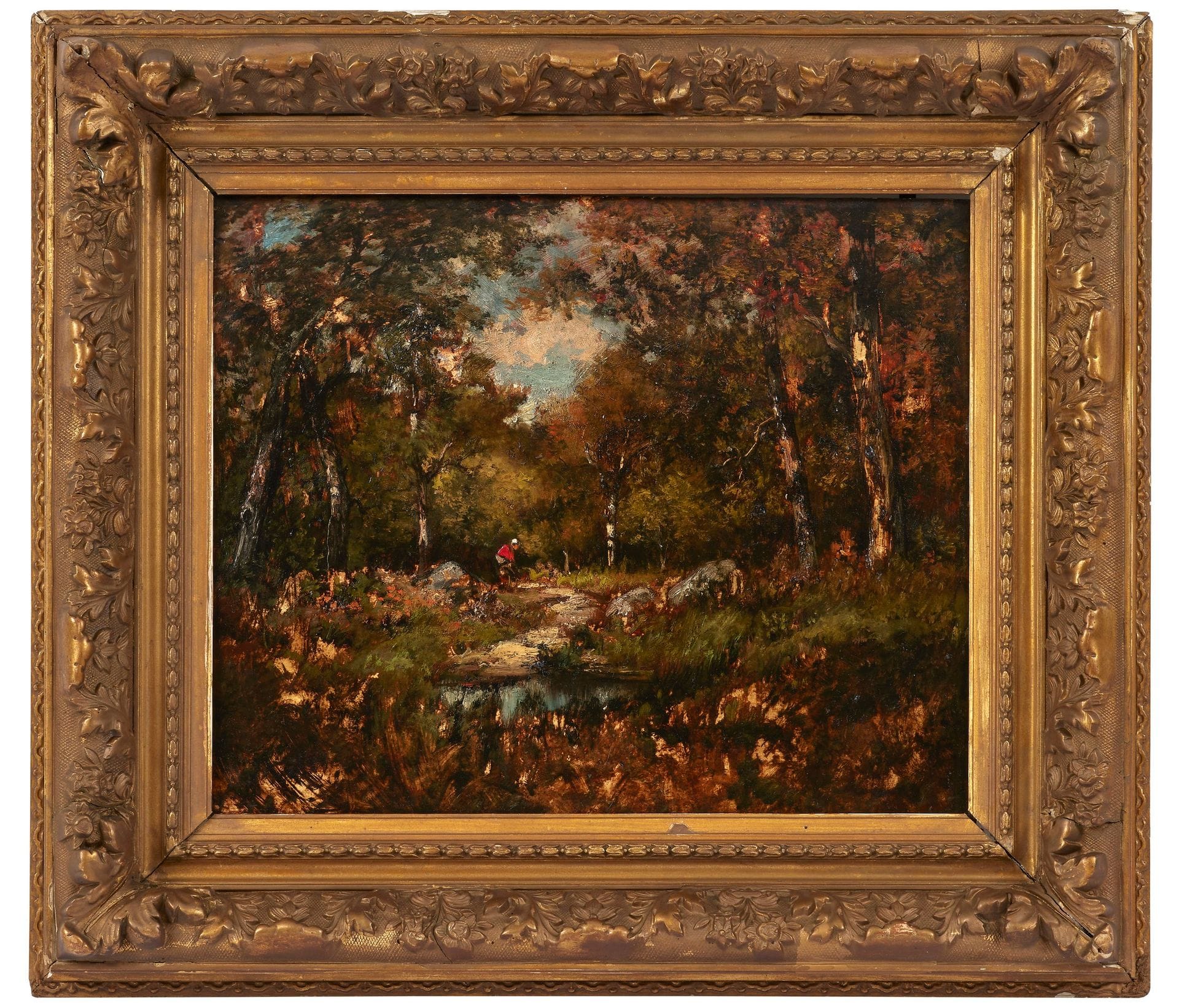
Chemin en forêt de Fontainebleau, circa 1850
Oil on mahogany panel, 37.5 × 46.5 cm. Sold for €12,160 at Osenat in July 2026
The Barbizon School: painters, history and auction prices
Ahead of our “L’Esprit du XIXe siècle” auction on Sunday 22 November 2026 in Fontainebleau, a look back at the Barbizon School: the painters who turned the forest of Fontainebleau into an open-air studio, and whose works are sought after today by collectors around the world.19th-century paintings department
What is the Barbizon School?
The Barbizon School was not a school in the teaching sense. It was a group of landscape painters who, from around 1830 to 1870, came to work in the forest of Fontainebleau, around the village of Barbizon, then a mere hamlet of Chailly-en-Bière.
Their aim was to make landscape a subject in its own right, painted from nature, far from the idealised historical landscape taught in the studios of the time. Oaks, ponds, rocks, heathland and the rural life of the plain became the motifs of a new kind of painting.
The painters of the Barbizon School
Around a few major figures, dozens of artists, great and lesser masters alike, worked in the forest of Fontainebleau:
- Théodore Rousseau (1812-1867), the central figure of the group, who set up his studio in Barbizon in 1847;
- Jean-François Millet (1814-1875), who arrived in 1849 with Charles Jacque to escape the cholera epidemic in Paris, and lived there until his death;
- Narcisse Diaz de la Peña (1807-1876), painter of undergrowth and filtered light;
- Camille Corot (1796-1875), who painted regularly in the forest of Fontainebleau;
- Charles-François Daubigny, Jules Dupré and Constant Troyon, landscape painter and great animal painter;
- Rosa Bonheur (1822-1899), who settled at the Château de By, in Thomery, on the edge of the forest.
The characteristics of Barbizon painting
- Working from the motif: the painters made their studies outdoors, facing the landscape, before reworking them in the studio.
- Landscape for its own sake: nature is no longer a backdrop for a mythological or historical scene; it becomes the subject of the painting.
- Rural life: shepherds, gleaners, herds and farm work, observed without idealisation, paved the way for Realism.
- Light and sky: sunlight through the foliage, stormy skies, evening light, often in a restrained palette of greens and earth tones.
In this, Barbizon heralded Impressionism. In the 1860s, young painters such as Claude Monet came to work in the forest in turn: it was in Chailly-en-Bière that Monet prepared his Déjeuner sur l’herbe in 1865.
Fontainebleau, Barbizon, Chailly-en-Bière: a land of painters
In Barbizon, the artists met at the Auberge Ganne, now the departmental museum of the Barbizon School. Millet painted The Angelus on the plain of Chailly, whose church tower can be seen on the horizon.
The painters also defended “their” forest: at their request, artistic reserves were withdrawn from logging from 1853, then made official by an imperial decree in 1861. They are often described as one of the very first nature protection measures in the world.
Osenat is based at the heart of this land: in Fontainebleau, at the Hôtel d’Albe, where our 19th-century painting auctions are held, and in Chailly-en-Bière, home to our Angélus saleroom. In 2025, the house donated a work by Rosa Bonheur to the artist’s château in By-Thomery.
The Barbizon School at auction: what are the paintings worth?
For 30 years, Osenat has held three auctions a year devoted to 19th-century painting. Some recent results for the painters of Barbizon and the forest of Fontainebleau:
- Rosa Bonheur, Étude de cheval brun: estimate €18,000–25,000, sold €64,000 (July 2026)
- Théodore Rousseau, Chemin en forêt de Fontainebleau, circa 1850: estimate €8,000–10,000, sold €12,160 (July 2026)
- Théodore Rousseau, Le berger dans les Landes, charcoal drawing: estimate €3,000–4,000, sold €6,552 (April 2024)
- Georges Michel, a forerunner of landscape painting from nature, Coup de soleil après la pluie: estimate €1,500–2,000, sold €6,400 (March 2026)
- Jean-François Millet, Étude de jeune fille et reprise d’une tête, black pencil drawing: estimate €700–1,000, sold €3,780 (April 2024)
The value of a Barbizon School painting depends on the artist, the subject, the technique (oil or drawing), the size, the condition and the provenance. Authenticity matters greatly: several of the works above were confirmed by the author of the artist’s catalogue raisonné. Works by lesser masters and paintings simply attributed to the Barbizon School also find their place in our sales.
“L’Esprit du XIXe siècle” auction, 22 November 2026
Our next 19th-century painting auction will take place on Sunday 22 November 2026 at 2 pm in Fontainebleau, with bidding in the saleroom and online.
Do you own a Barbizon School painting or a 19th-century work? Our specialist offers a free, confidential valuation with no obligation, online or by appointment, with a view to our upcoming sales. See also our 19th-century paintings department.
Frequently asked questions
When did the Barbizon School begin?
Painters began coming to the forest of Fontainebleau in the 1820s and 1830s. The group took shape around Théodore Rousseau, who settled in Barbizon in 1847, and Jean-François Millet, who arrived in 1849. Its golden age lasted until the 1870s.
How can I recognise a Barbizon School painting?
The subject (undergrowth, ponds, oaks, heathland, rural scenes), the palette and the brushwork give the first clues. A signature is not enough: pupils and followers were very prolific. Send us photographs of the work, its signature and its back, and our specialist will reply free of charge.
How much is a Barbizon School painting worth?
Depending on the artist and the work, results range from a few hundred euros for a study or a lesser master to several tens of thousands of euros for a fine work by Rosa Bonheur or Théodore Rousseau. Only a valuation by a specialist can place your painting.
Next auction
L’Esprit du XIXe siècle
Sunday 22 November 2026 at 2 pm
Hôtel d’Albe, 9-11 rue Royale, 77300 Fontainebleau, France
Contact
Julie Alves
Specialist, 19th-century paintings department
+33 (0)6 88 45 76 56
j.alves@osenat.com