

Lot n° 94
Estimation :
100000 - 180000
EUR
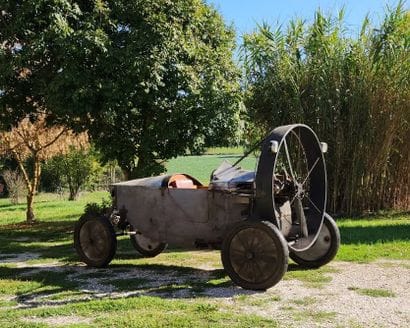
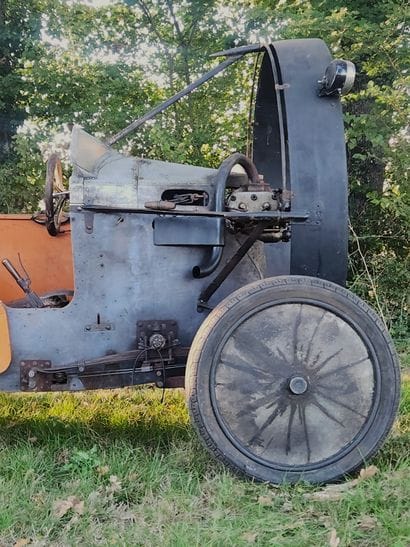
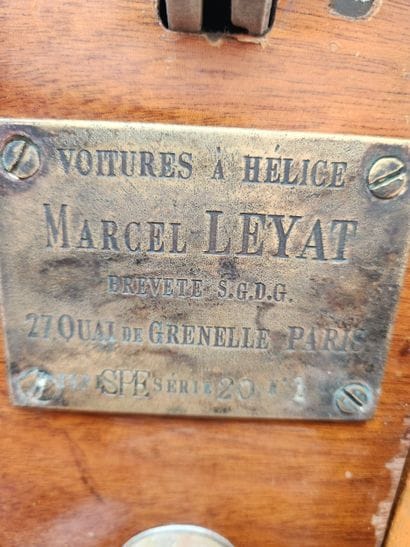
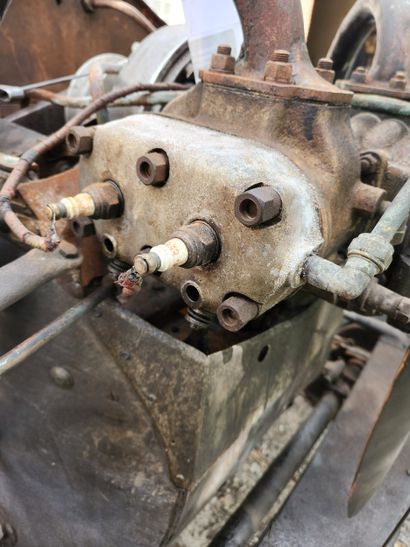
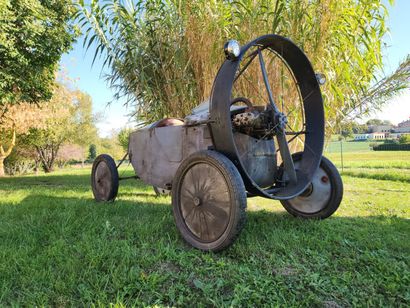
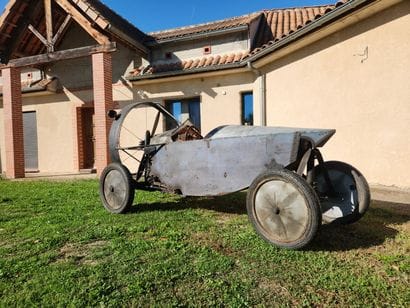
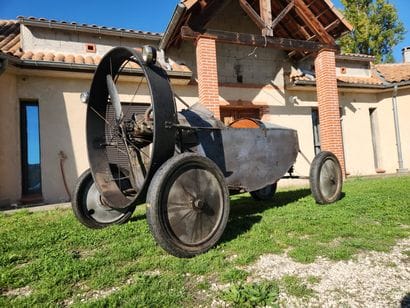
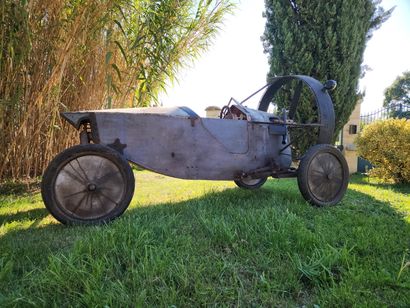
80s rebuild of a Helica Type SPE (special) - Lot 94
80s rebuild of a Helica Type SPE (special)
Series 20 N° 1
To be registered as a collector's item
Marcel Leyat was born in Die, Drôme, in 1885. His family came from Mieussy. After attending school in Die, then the Lycée Champollion in Grenoble, where he was nicknamed the "Butterfly Man" for his jumping tests, he entered the Ecole des Arts et Manufactures in Paris, which became the Ecole Centrale, in 1907, graduating as an engineer in 1911. In 1908, aviation was in its infancy. Henry Farman makes the 1st one-kilometer closed-circuit flight on a Voisin bi-plane powered by a 50hp Antoinette V8 engine. In 1911 Marcel Leyat made his 1st flight with his glider. In 1912, Peugeot's CEO Robert Peugeot created a prize for any cyclist who managed to fly more than 10 meters round trip. Marcel Leyat took part in this prize with his 2-wheeled helicycle. Released from his military duties, Leyat worked for Astra, a manufacturer of airplanes and airships, and helped design the Astra 14. He left the company in 1913 to work on his first propeller-driven car: the helicocycle. In those days, there was no modeling, no wind tunnels and no computers, but there was experimentation; Marcel Leyat developed an aeronautical simulator before the war. Leyat's automobile business began in November 1913. This helicycle had a characteristic streamlined shape, fir-wood construction, engine at the front and steering at the rear. The outbreak of the First World War prevented Leyat from commercializing his invention. The car followed him to the front for a few months, in the artillery. He proposed to the military authorities the use of the helicycle as a liaison vehicle; the army asked to carry out tests, but the project came to nothing. In 1919, Leyat worked as an engineer for Levasseur, a propeller manufacturer, who financed the construction of a new version of his propeller-driven car, the Hélico. When the latter was completed, Levasseur gave up on mass production, leaving the prototype to Leyat. The car was exhibited at the Paris Motor Show in late 1919. The press devoted many articles to the Leyat 1919 propeller car. Leyat envisaged mass production. Lacking the financial means to mass-produce the car, he sold his manufacturing license to Archer, also an engineer, and the chopper became known as "Hélica". Archer produced 5 for Leyat. Inspired by the Hélica, Archer designed another propeller-driven car, the Eolia, and marketed it at the same time as the Hélica. Leyat took him to court for counterfeiting. The Hélica is reminiscent of an airplane (hence its nickname, the wingless plane), giving it good air penetration. It's worth noting that 60% of the power used is to overcome air resistance. Another very serious source of power loss lies in the transmission and propulsion components: gears, wheels (30% to 40% of motive power). What's more, it also depends on road conditions (hard, sandy, icy, muddy, etc.) and atmospheric conditions. All these disadvantages were eliminated by replacing all differential transmissions and the rear axle with an overhead propeller directly connected to the engine. In 1921, Leyat took over construction and designed a new version of his propeller-driven car. The bodies were made by Ratier, a propeller manufacturer. Leyat took care of the assembly and mechanics. A series of 10 cars was produced between 1921 and 1922. A sports version was added in 1921, in 3 examples. An interior-drive car was purchased by Mr. Peugeot, who had only just arrived. The sports version was bought by Mr. Gustave Courau, who drove it for ten years before donating it to the CNAM museum in 1930, where it is now on display. Production did not resume in 1922, and Leyat concentrated on aviation. In 1927, Leyat set a speed record of 170km/h on the Montlhéry ring.
23 vehicles were built, of which only three have survived to this day. The first, in "indoor driving" condition, belongs to an heir of the Peugeot family, and has just been acquired by the Louwman Museum, while the second, a sports model, is on display at the Musée des Arts et Métiers. Today we present the third.
This automotive revolution dates back over a century! Few people were aware of the talent, audacity and genius of this inventor. This is a major discovery for the history of the Au
My orders
Sale information
Sales conditions
Return to catalogue