

Lot n° 224
Estimation :
30000 - 50000
EUR
Result with fees
Result
: 49 400EUR
Giovanni BOLDINI (ITALY-FRANCE/ 1842-1931) - Lot 224
Giovanni BOLDINI (ITALY-FRANCE/ 1842-1931)
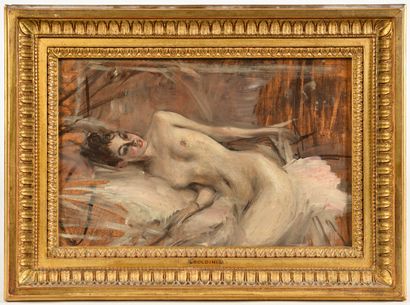
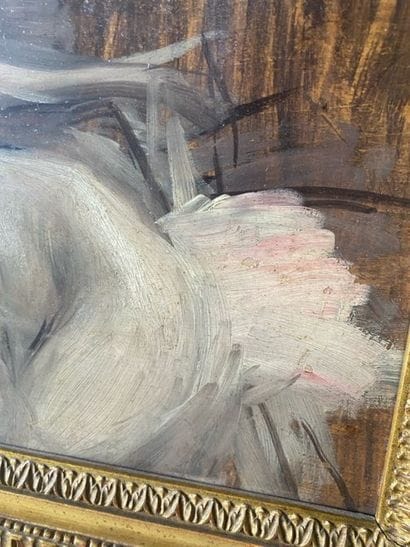
Reclining nude woman, circa 1910-20
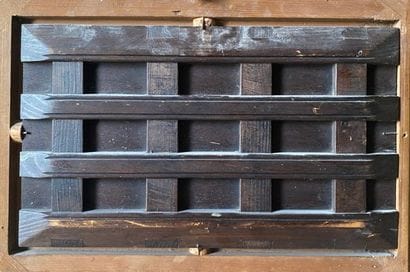
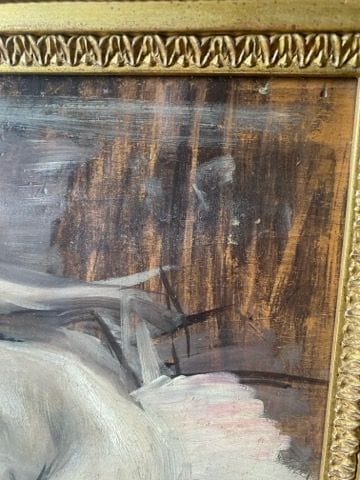
Oil on parquet panel
20.5 x 35 cm
A certificate of authenticity from Francesca Dini no. 002761 will be given to the buyer.
Expert : M. Thomas MORIN-WILLIAMS
NOTA :
"Movement and speed are one of the aspects of his modernity." - Servane Dargnies de Vitry, curator of the exhibition 'Boldini' from March 29 to July 24, 2022 at the Musée du Petit Palais, Paris.
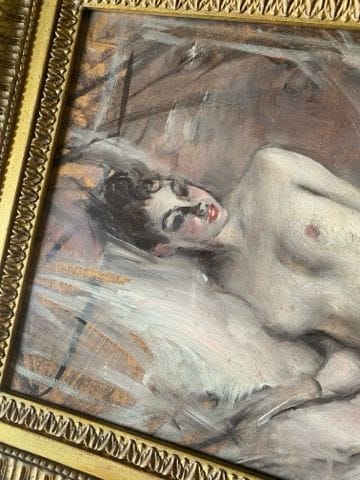
"The brushstrokes rise soft and wispy, laden with pink nuances, while the brown and golden strokes quickly draw the languor-laden atmosphere expressed by the model's extremely sensual and beautiful features." - Francesca Dini, art historian and Giovanni Boldini specialist.
---
A "signature work" by one of the masters of modern social portraiture, Giovanni Boldini embodied the best of Belle Époque art during his lifetime, among whom in Europe were Paul-César Helleu, James Whistler, John Sargent, Anders Zorn, Giuseppe de Nittis and Ramon Casas. A "child of art", as historian Francesca Dini reminds us, Giovanni Boldini is one of those artists from a family of painters who transcended his forebears. Born in Ferrara in 1842, Boldini was the eighth of thirteen children of the painter Antonio Boldini (1799-1872).
The master of Ferrara was trained in his native city by the example of Cosmè Tura (1430-1495) and Dosso Dossi (1489-1542), both initiators of the early Renaissance in Ferrara in the 15th and 16th centuries. Predisposed to artistic technique and with an independent temperament, the young Boldini was encouraged by his father Antonio to take up painting as a profession in the late 1850s. After a formative stay in Florence with the Macchiaioli, Boldini moved to Paris in 1871, attracted, like many painters, by the artistic dynamism of the capital.
A classicist by training, with an ear for the innovations of his generation, yet with a marked independence of spirit, Giovanni Boldini enjoyed a meteoric rise from his debut at the Paris Salon in 1874, and was soon the subject of continuous success until his death in 1931 - a rare occurrence for an artist. He quickly became one of the most sought-after artists in the Goupil stable.
Francesca Dini, a historian specializing in Boldini, abounds with details of the present work:
"Success came with small paintings of extraordinary craftsmanship and gentleness depicting sometimes gallant scenes inspired by the eighteenth century, a sometimes elegant slice of life in which the lively brushstroke of the rococo is applied to the reality of the modern metropolis. In the 1880s, Boldini returned to the genre of portraiture, his youthful passion, depicting the actors of the Belle Epoque in large-scale paintings that made him internationally famous among the "worldly portraitists" of his time.
It is precisely in this last section of the Italian painter's artistic career that the present painting is situated: it is - to clarify - through the segment that starts with the intimate portraits of Countess Gabrielle De Rasty, his noble lover, via the magnificent Portrait of Whistler (New-York, The Brooklyn Museum), that Boldini then enters the 20th century through the present nude. Our painting, representing a theme dear to the artist, that of the model's repose (often the lover of the moment), is typical of the works of the early new century.
Boldini, known for the dynamism of his dazzling brushstrokes, for the serpentine verticality of the lines that caress the slender, sinuous bodies of aristocratic models, was constantly drawn to the theme of the female nude at rest; so much so that these "fragments" of intimacy, of abandonment among the candied blankets of alcoves, are very recurrent, almost a counterpoint in the artistic life of the seductive painter, to the ostentatious grandeur of official portraits.
The present painting is to be compared with "Nu d'une jeune femme allongée" (see PIERO DINI - FRANCESCA DINI, "Giovanni Boldini 1842-1931, Catalogue raisonné, Allemandi, Turin 2002, vol. III, vol. II, n. 1020).
The Italian master's choice of a reduced chromatic range expresses an extraordinary modernity of vision, and the feeling of intimacy that binds painter and model is legible with the characteristic white covers."
Boldini, recognized as soon as he arrived in Paris in 1871, was honored by the French state: President of the Italian section of the Paris Universal Exhibition in 1889, member of the Société nationale des Artistes français in 1879, he was awarded the insignia of Chevalier de la Légion d'Honneur in 1889.
My orders
Sale information
Sales conditions
Return to catalogue