
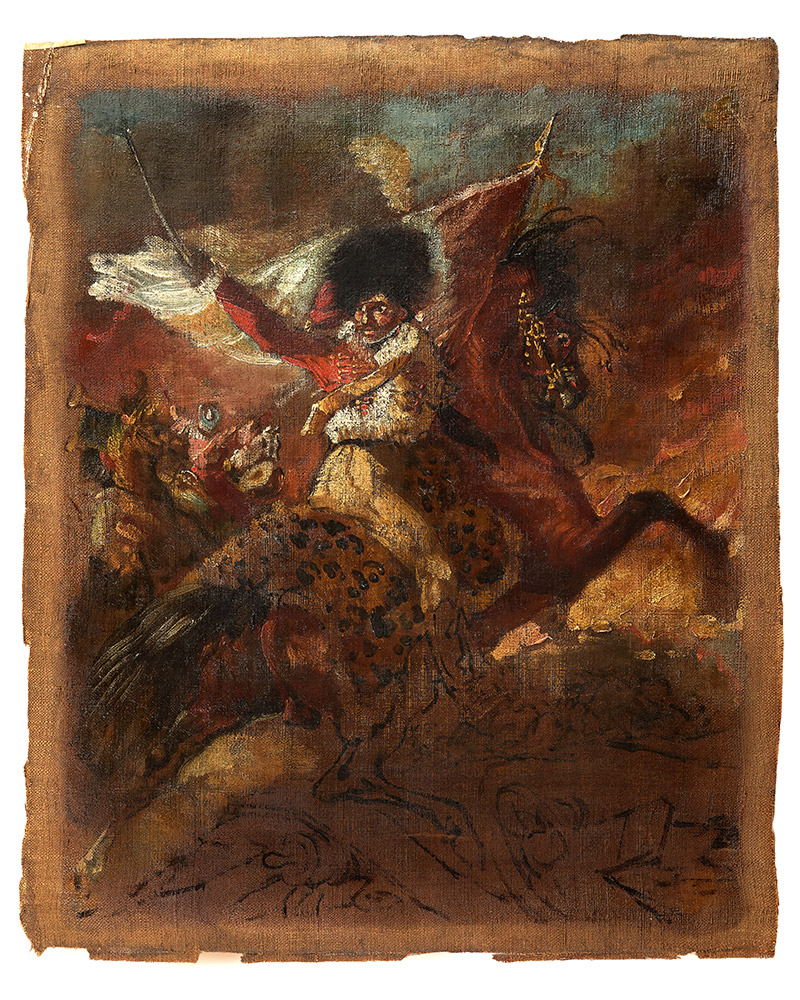
Théodore GÉRICAULT (Rouen 1791 – Paris 1824)
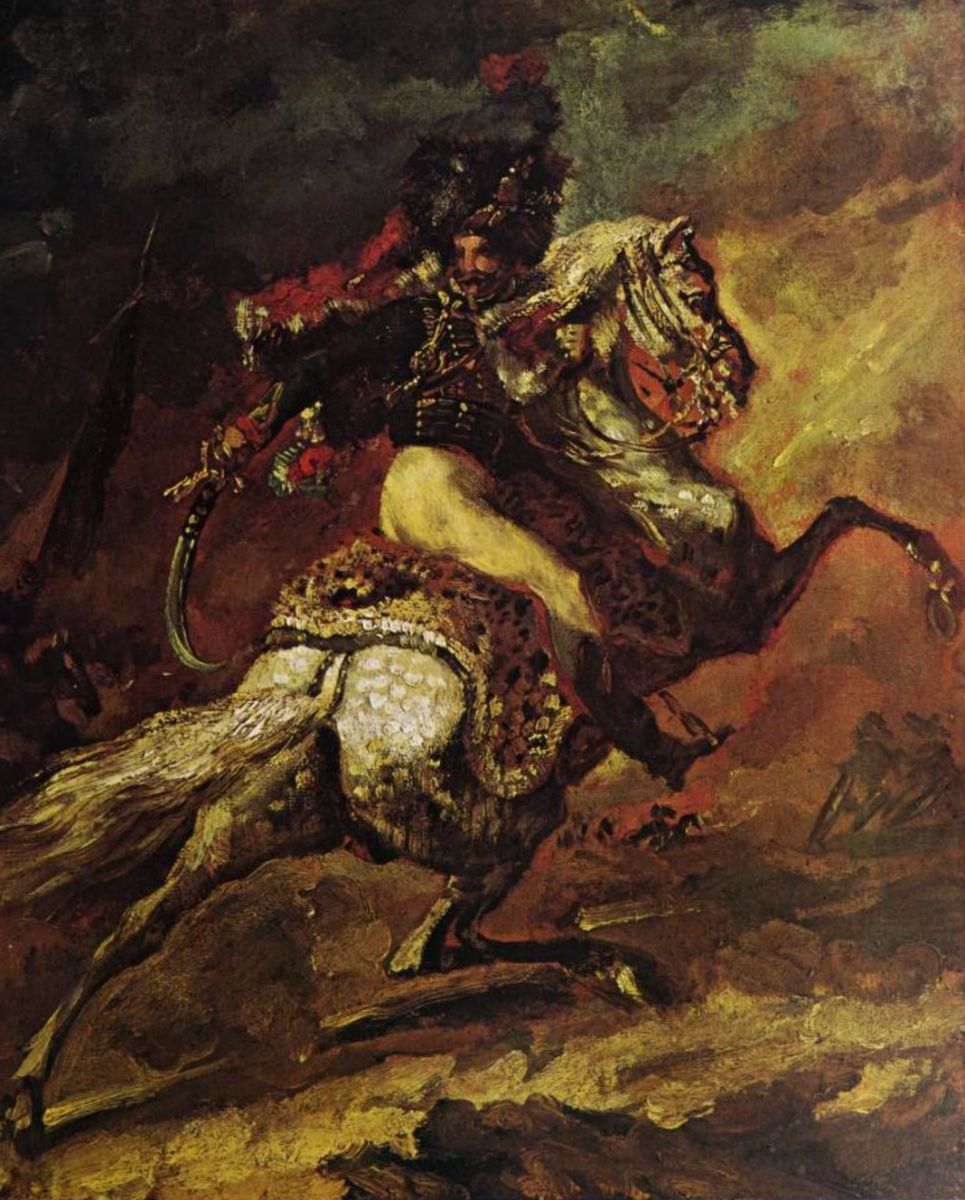
An Officer of the Imperial Guard Chasseurs Charging / The Descent from the Cross
On its original canvas, double-sided — 53 × 44 cm
The Birth of a Masterpiece: Théodore Géricault's Preparatory Sketch for the Louvre's Officer of the Chasseurs
On Sunday 22 March 2026, as part of the sale Les Collections Impériales — Second Day, Osenat is offering at auction a discovery of exceptional rarity: a double-sided canvas by Théodore Géricault, bearing on one face a copy after Jouvenet and on the reverse the earliest known sketch for An Officer of the Imperial Guard Chasseurs Charging, a masterpiece in the collections of the Musée du Louvre. Estimate: 300,000 – 400,000 €.
'This painting marks a decisive turning point in the artist's early years of formation — it is the work with which Géricault became Géricault.' René Millet
The canvas is painted on both sides. The first face bears The Descent from the Cross, after the painting by Jouvenet executed in 1696 for the church of the Capucines and acquired by the museum — the future Louvre — in 1796. Jouvenet's composition had long been regarded as the pinnacle of classical painting, perhaps its swan song, bringing to a close the century of Poussin and Le Brun. It is therefore unsurprising that Géricault should have copied it; yet he did so with a powerful impasto and a bold touch remarkable in a copy, already announcing his mature style — that of The Raft of the Medusa.
Géricault had first studied under Carle Vernet from 1808 to 1810, then under Pierre-Narcisse Guérin, before enrolling at the École des Beaux-Arts in Paris in 1811, where he practised copying in the Musée Napoléon (the Louvre), studying Titian, Le Sueur, Rubens, and Jouvenet among others. The present canvas is to be dated to this period. It is cited by Clément as no. 174, with the specific note that on the reverse of the canvas appears a sketch for the Officer of the Chasseurs.
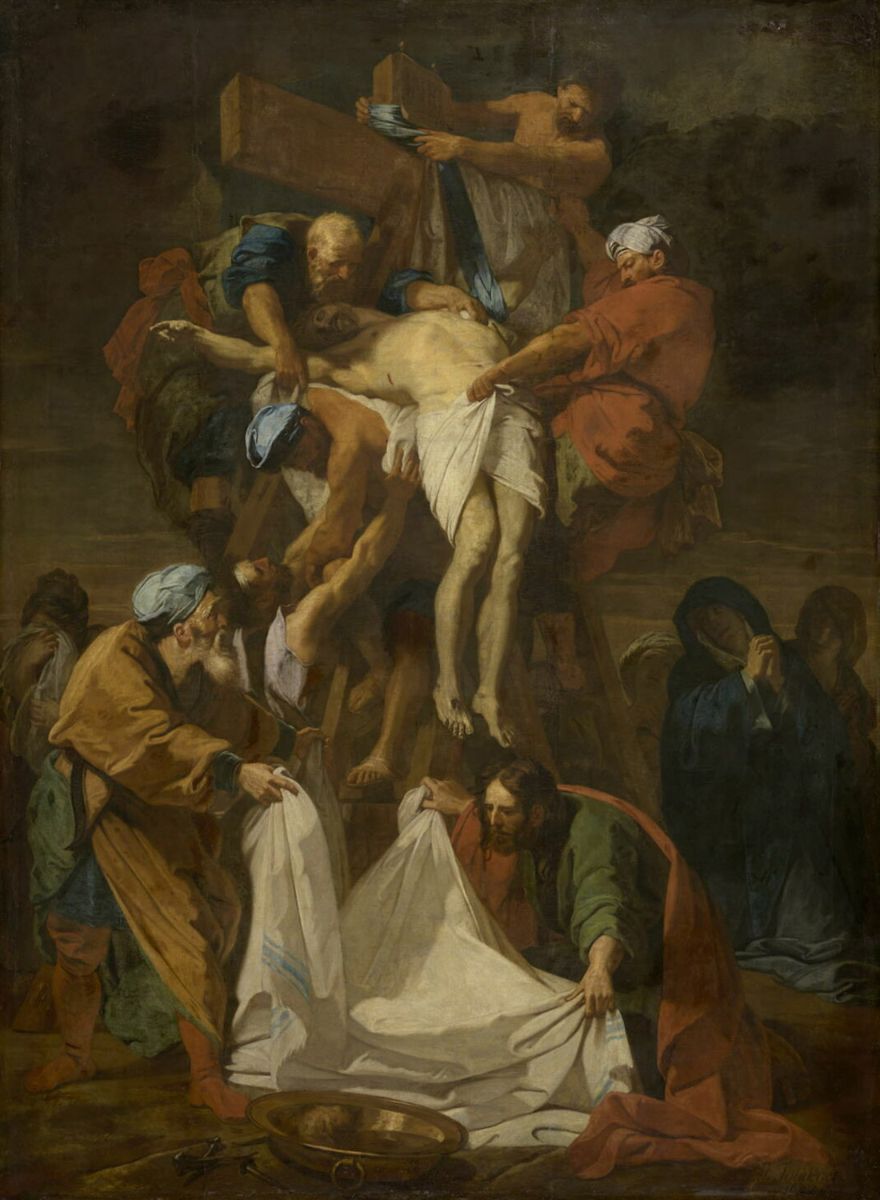
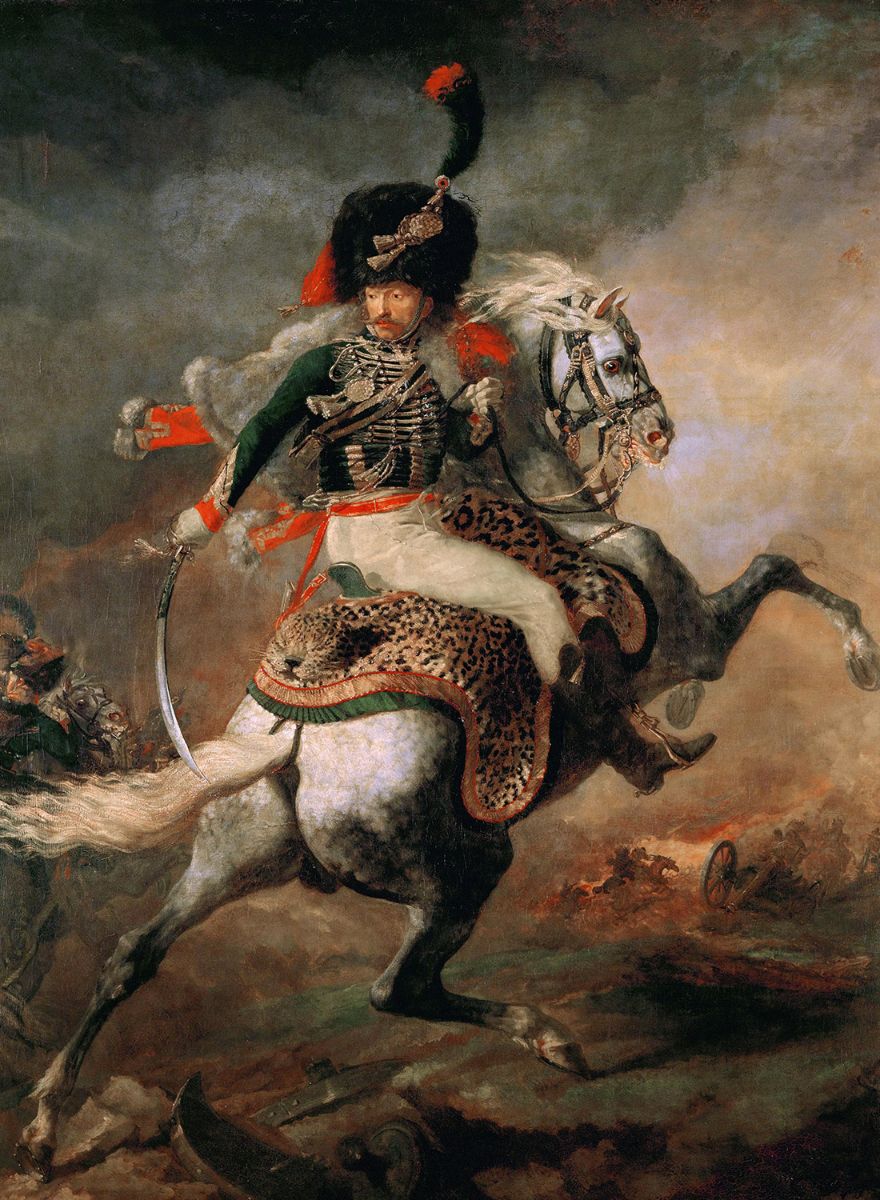
Left: Jean Jouvenet, The Descent from the Cross, 1696, Musée du Louvre — Right: Théodore Géricault, An Officer of the Imperial Guard Chasseurs Charging, 1812, Musée du Louvre © DR
One Canvas, Three Works
A remarkable discovery, though not entirely surprising in this context: a third work is concealed within the canvas. Under infrared examination, a male portrait emerges beneath The Descent from the Cross. The reuse of a canvas was common practice among artists in training, who readily recycled previously sketched supports as working grounds for their studies.
Over this portrait, Géricault painted his version of The Descent from the Cross, then on the reverse delivered his first independent work: an officer of the chasseurs, rapidly sketched, in which the energy of his brushwork already displays the virtuosity that would define him. The sketch is of particular interest in that it reveals the artist's working process at several stages of execution. The upper portion comprises cavalrymen whose movement is conveyed by a rapid, flame-red background evoking the chaos of battle. The lower portion is simply drawn in brush: the horse's limbs are indicated by a single black line. It constitutes the first idea for the great Louvre canvas, An Officer of the Imperial Guard Chasseurs Charging (canvas, 292 × 194 cm).
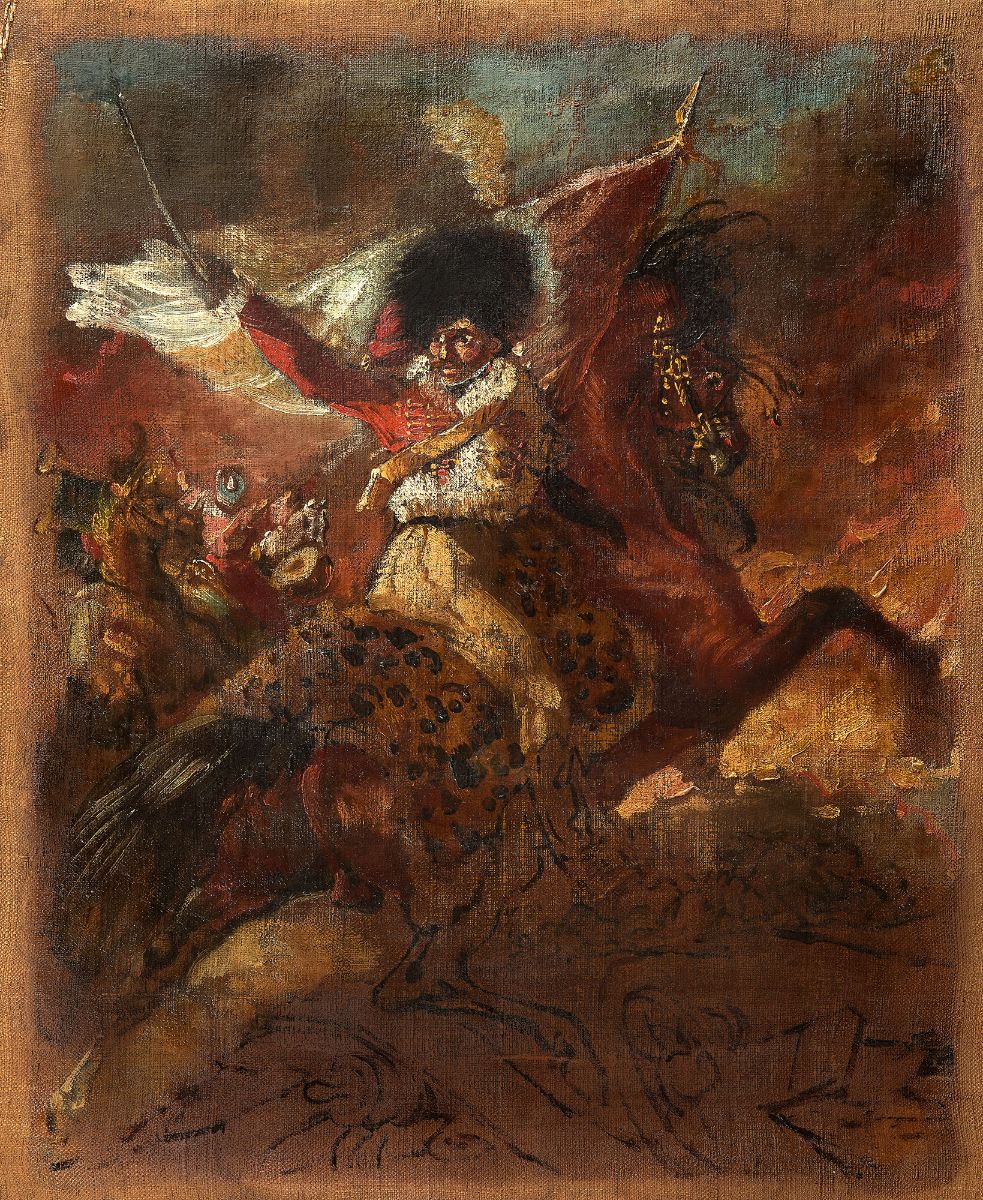
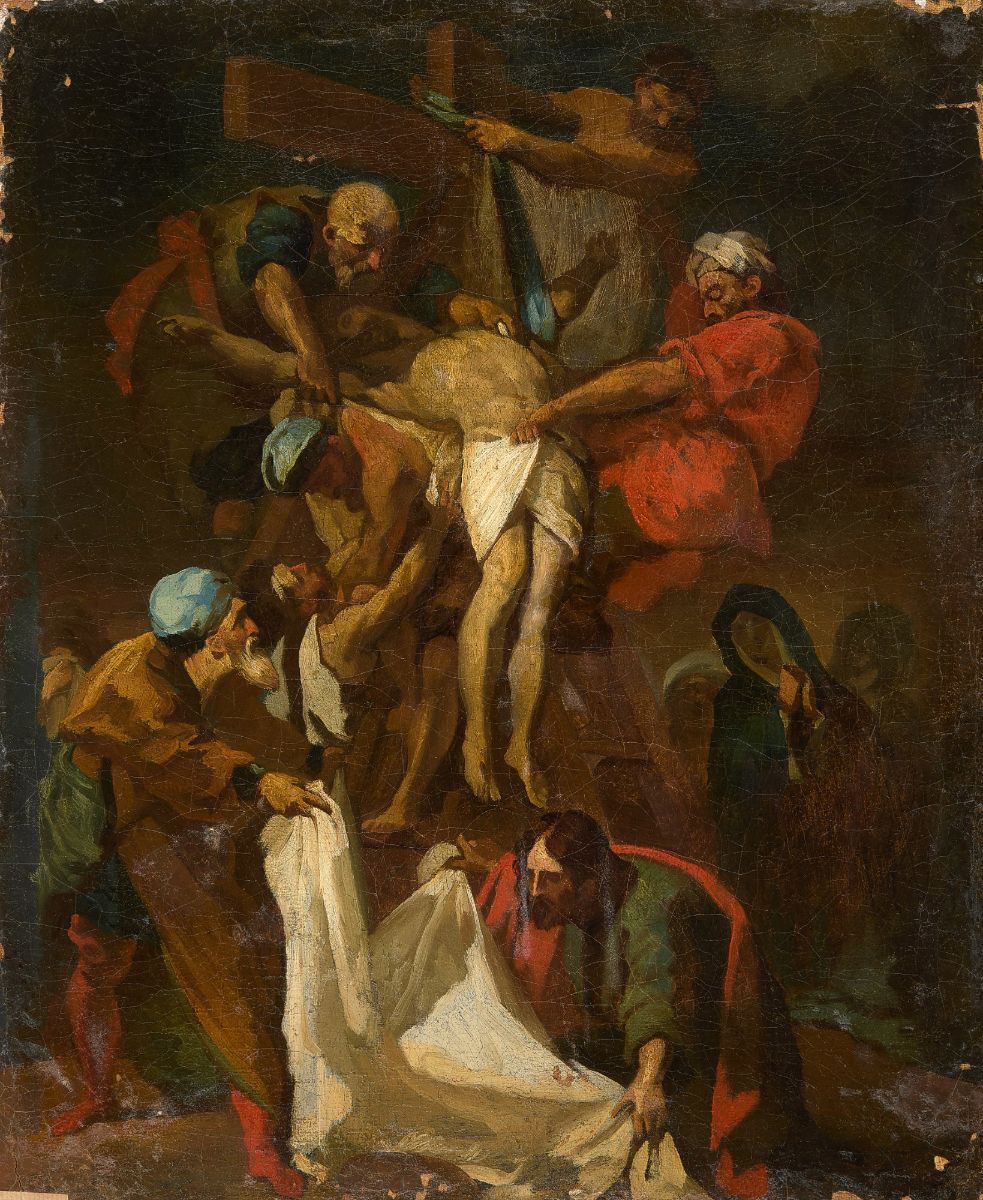
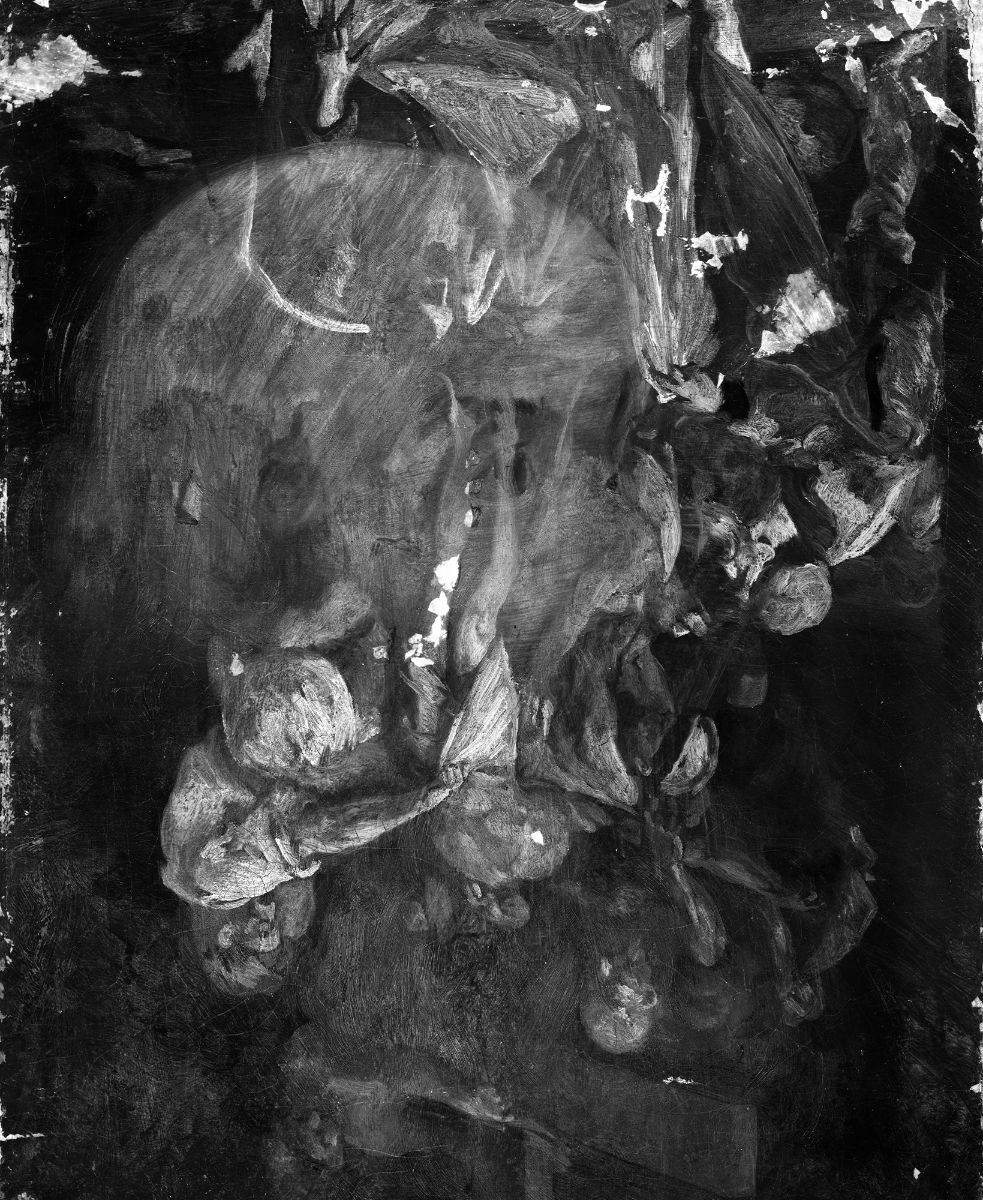
Left to right: The sketch of the Officer of the Chasseurs (verso) — Géricault, The Descent from the Cross (recto) — Infrared examination, beneath the Descent from the Cross © Atelier Catherine Polnecq
The Birth of a Myth
The Louvre painting, the young Géricault's first official submission at the age of twenty-one, was shown at the Salon of 1812. According to Clément, the subject originated in an encounter with a grey horse on the road to Saint-Cloud. The animal reared up, and the scene made a powerful impression on Géricault, who resolved to elevate it by investing it with historical dimension. He painted his chasseur at a moment when the Empire was suffering its first serious setbacks during the Russian campaign. Called up in April 1811, he escaped conscription; his replacement, Claude Petit, died a few months later.
This type of representation, conventionally reserved for equestrian portraits of generals — as in David's Napoleon Crossing the Alps or Gros's Murat at the Battle of Eylau — here portrays an unknown to the public at large, Alexandre Dieudonné, a friend of the artist, thereby embodying any young lieutenant risking his life for the Empire. To paint the large canvas, Géricault took premises on the site of the present-day Passage Jouffroy, where a carriage-hire firm had stood in 1806. He thus had an inexhaustible supply of models, and had a cab horse brought to him each morning. He is said to have completed the large painting in just twelve days, though the number of preparatory sketches — some dozen in all — attests to a long prior period of reflection.
The Genesis of a Composition
The earliest projects — among them the present sketch, the drawing in the Louvre, and the sketch from the Piot collection (now in a private collection in Japan) — share the horse turned to the right, the standard, and the uniform with a closed jacket.
In a second phase, the horse becomes grey and turns to the left, as seen in the sketches held at the Louvre, at Rhode Island, and formerly in the Delon collection. Géricault ultimately returned to his original idea for the pose and composition, retaining certain modifications — notably in colour — and producing a final group of sketches to which the Rouen painting belongs, bringing his reflections to a close by synthesising the ideas that had preceded it.
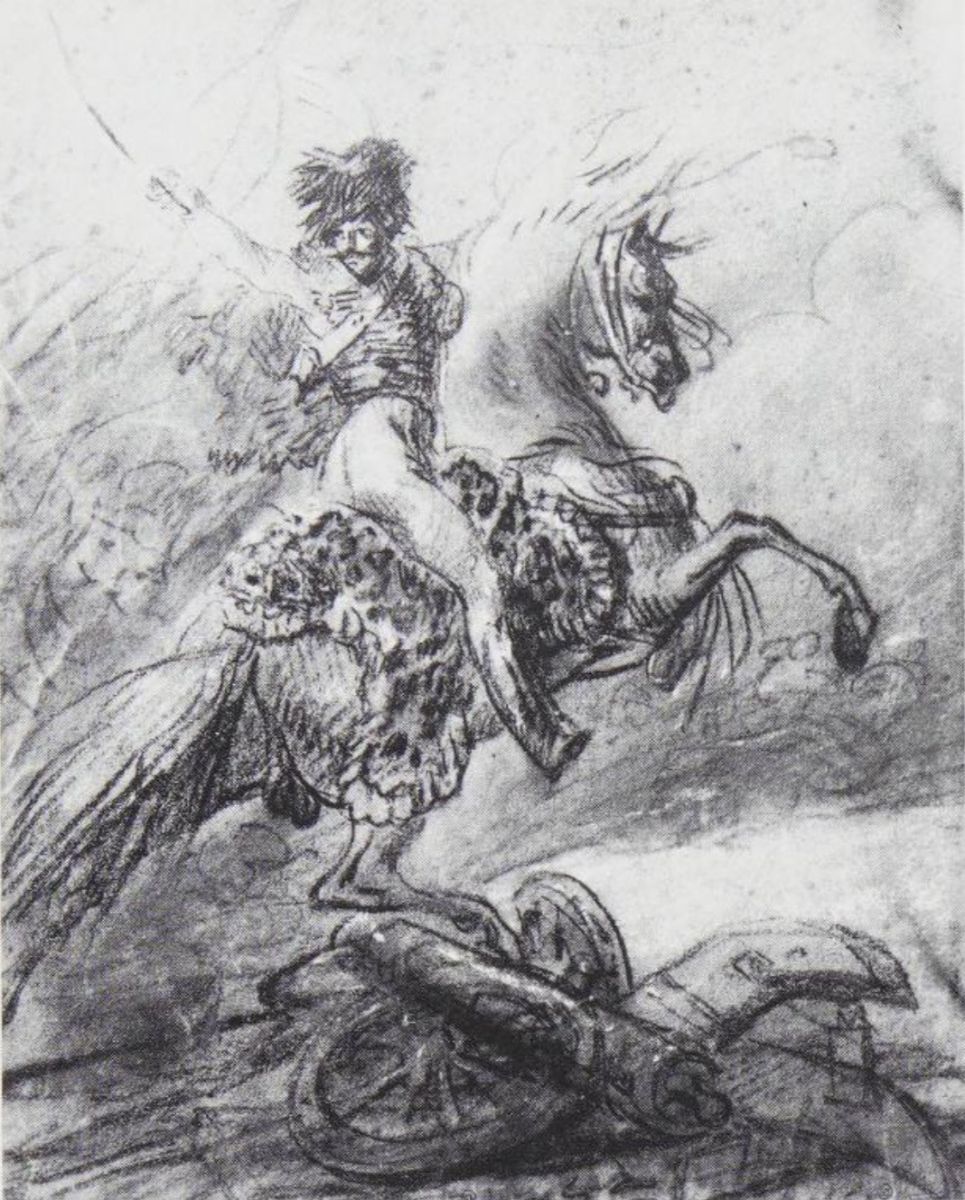
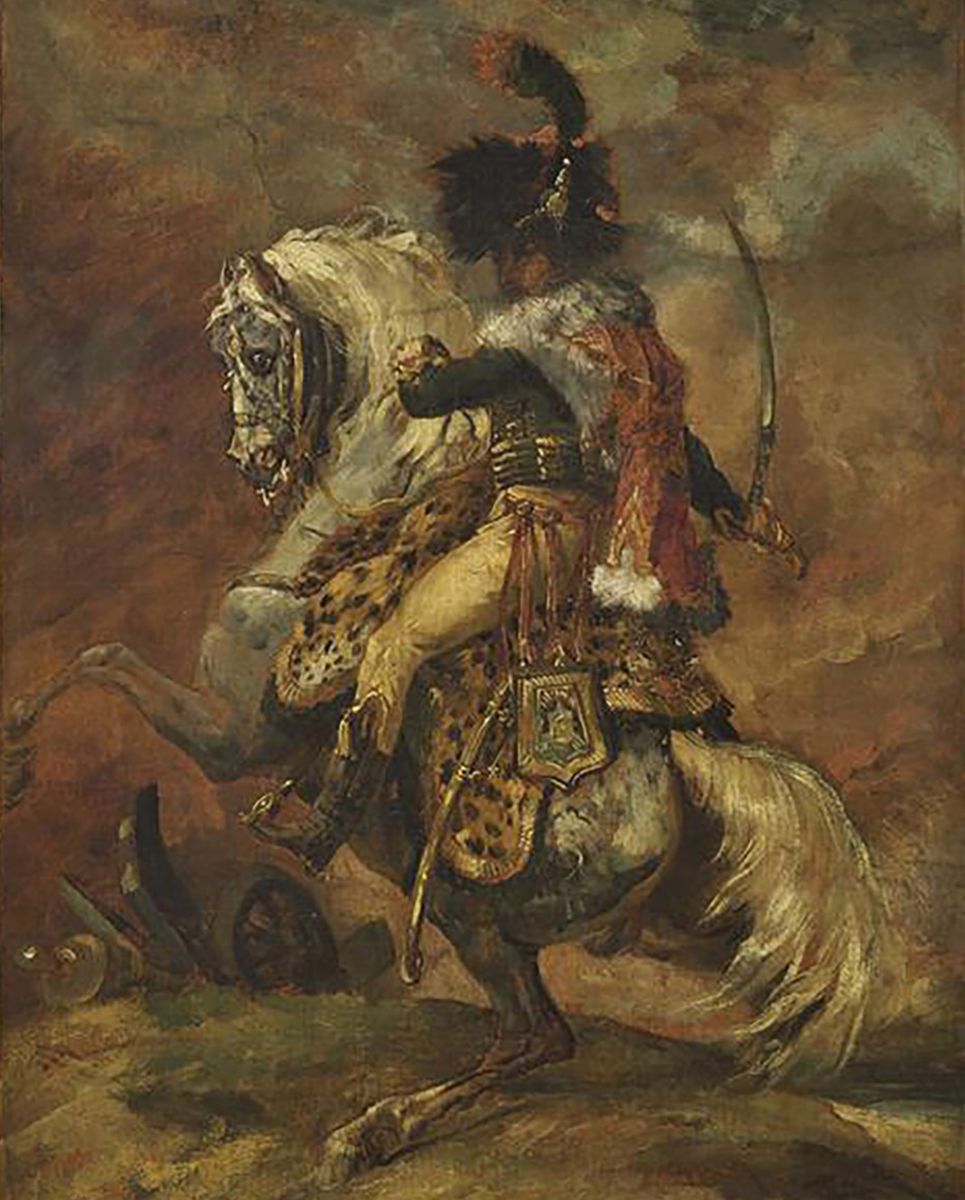
Left to right: Drawing, Musée du Louvre — Sketch, Rhode Island School of Design Museum — Sketch, Musée des Beaux-Arts de Rouen © DR
The Feuillet de Conches Collection
The present work formerly belonged to Félix Feuillet de Conches (Paris, 1798–1887), an eclectic collector of wide-ranging interests and a man of many parts: art historian, diplomat, writer and journalist. He entered the Ministry of Foreign Affairs on the recommendation of Talleyrand in 1824, where he held the position of head of bureau in the protocol department.
He began assembling his impressive collection around 1835, aided by his extensive connections in diplomatic circles. Inquisitive and learned, he gathered objects as diverse as they were rare and eccentric: Italian Renaissance paintings, French and English paintings, rebuses, wax portraits, archaeological objects… In 1861 he published Causeries d'un curieux, touching on several of these areas of interest.
Feuillet de Conches evidently had a particular interest in Géricault, as his collections include a letter from the painter Théodore Lebrun to Louis Batissier, written in 1836. A close friend of Géricault, Lebrun provides in this letter numerous biographical details about the artist, information which was subsequently drawn upon by Clément.
Information
Auction
Les Collections Impériales — Second Day
Sunday 22 March 2026 at 2.30 pm
Lot 301 — Estimate: 300,000 / 400,000 €
Preview in Paris
Tuesday 17 March 2026, 6–8 pm
66 avenue de Breteuil, 75007 Paris
Public exhibitions in Fontainebleau
Friday 20 March: 10 am–12 pm and 2–5 pm
Saturday 21 March: 10 am–12 pm and 2–5 pm
Sunday 22 March: 10 am–12 pm
9–11, rue Royale, 77300 Fontainebleau
Contacts
Jean-Christophe Chataignier
Managing Director
+33 (0)1 80 81 90 04
jc.chataignier@osenat.com
Raphaël Pitchal
Executive Assistant
+33 (0)7 86 17 55 19
empire@osenat.com
Specialist
René Millet
Press coverage:
Point de Vue — Géricault's studies before his masterpiece
Gazette Drouot — A cavalcade for Géricault and the First Empire